




How Many Songbirds vs Birds of Prey Photographed?
Let's Draw It
Before diving into equations, let's visualize what we know about the contest scoring system:
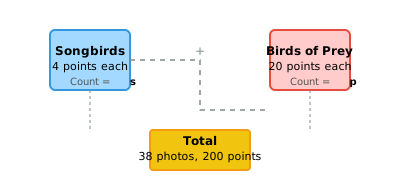
This diagram shows our two unknowns (s songbirds and p birds of prey) combining to give us our two known totals. Each constraint will give us one equation.
What This Problem Teaches
- Setting up systems of linear equations from real-world constraints
- Recognizing when two different "totals" create two separate equations
- Using substitution method to solve systems efficiently
- Interpreting solutions in context (whole numbers of photos make sense)
- Checking answers by verifying both original conditions
Solution: Method 1 — The Substitution Approach
Step 1 — Define variables
Let s = number of songbird photos and p = number of birds of prey photos.
Step 2 — Write the constraint equations
We have two pieces of information that give us two equations:
s + p = 38 (total number of photos)
4s + 20p = 200 (total points scored)
Step 3 — Solve the first equation for one variable
From the first equation: s + p = 38
Solve for s: s = 38 - p
Step 4 — Substitute into the second equation
Replace s with (38 - p) in the points equation:
4(38 - p) + 20p = 200Step 5 — Solve for p
Distribute: 152 - 4p + 20p = 200
Combine like terms: 152 + 16p = 200
Subtract 152: 16p = 48
Divide by 16: p = 3
Step 6 — Find s
Substitute back: s = 38 - p = 38 - 3 = 35
Solution: Method 2 — Strategic Point Analysis
Step 1 — Consider the point difference
Notice that birds of prey are worth 20 - 4 = 16 more points than songbirds. This means every time we "trade" a songbird photo for a bird of prey photo, we gain 16 points.
Step 2 — Find the baseline
If all 38 photos were songbirds: 38 × 4 = 152 points
But we actually have 200 points, so we're 200 - 152 = 48 points above this baseline.
Step 3 — Calculate the trades needed
Since each songbird-to-prey trade gains us 16 points, we need:
48 ÷ 16 = 3 birds of prey
Step 4 — Find the songbird count
If 3 photos are birds of prey, then 38 - 3 = 35 are songbirds.
Verification
Let's check both constraints with our answer:
Total photos:35 + 3 = 38 ✓
Total points:35(4) + 3(20) = 140 + 60 = 200 ✓
Both conditions are satisfied, confirming our solution is correct.
Watch Out For These
✗ Setting up the wrong point equation
Writing 4s + 20p = 38 or s + p = 200. Always match the units: photos equation gets the photo total, points equation gets the points total.
✗ Arithmetic errors in substitution
Getting 4(38 - p) = 152 + 4p instead of 152 - 4p. When distributing 4 across (38 - p), the result is 4(38) - 4(p) = 152 - 4p.
✗ Forgetting to find both variables
Solving for p = 3 but not calculating s, or forgetting which variable represents which type of bird in the final answer.
How to Spot This Problem Type
Look for these telltale signs that signal a two-variable system:
- "Two types of..." items with different values or properties
- "Total of X items" plus "total value of Y" — two different ways to count
- Point systems, scoring systems, or value-per-item scenarios
- "Combined" or "altogether" suggesting multiple constraints
Similar problems appear as coin collections (pennies vs. nickels), ticket sales (adult vs. child), or mixture problems (two ingredients). The structure is always: count constraint + value constraint.
The Pattern Behind This
Every problem of this type follows the same general structure:
General Form:
x + y = total_items
value₁ × x + value₂ × y = total_value
Where x and y are quantities of two different types, value₁ and value₂ are the points (or cost, or worth) per item of each type.
The substitution method works particularly well because the first equation always gives you a simple relationship like x = total_items - y, which substitutes cleanly into the more complex second equation.
Where This Shows Up in Real Life
- Event planning: Budgeting for different ticket types with varying prices and seating limits
- Manufacturing: Production quotas where different products require different amounts of resources but contribute different profit margins
- Investment portfolios: Allocating money between two asset types with different risk profiles and return rates
Try These Variations
Let s = songbirds, p = birds of prey. We have s + p = 38 and 20s + 4p = 200.
From the first equation: p = 38 - s. Substitute: 20s + 4(38 - s) = 200
20s + 152 - 4s = 200, so 16s = 48, giving s = 3
p = 38 - 3 = 35
Answer: 3 songbirds, 35 birds of prey. Check: 3 + 35 = 38 ✓ and 3(20) + 35(4) = 60 + 140 = 200 ✓
s + p = 45 and 4s + 20p = 240
s = 45 - p, so 4(45 - p) + 20p = 240
180 - 4p + 20p = 240, giving 16p = 60
p = 60/16 = 3.75 birds of prey
s = 45 - 3.75 = 41.25 songbirds
Answer: 41.25 songbirds, 3.75 birds of prey. Note: Fractional photos suggest this specific contest scenario might not be realistic with whole photos!
Let s = songbirds, p = birds of prey, w = waterfowl
s + p + w = 40, 4s + 20p + 12w = 220, and s = 2p
2p + p + w = 40 gives w = 40 - 3p
4(2p) + 20p + 12(40 - 3p) = 220
8p + 20p + 480 - 36p = 220
-8p = -260, so p = 32.5
With p = 32.5, we'd have s = 65 and w = -57.5 (impossible!). This constraint set has no valid solution with whole photos.
30a + 8b = 200 (total points)
30a + 8(2a + 4) = 200
30a + 16a + 32 = 200
46a = 168
a = 168/46 ≈ 3.65
b = 2(3.65) + 4 = 11.3
Answer: a ≈ 3.65, b ≈ 11.3. Check: 30(3.65) + 8(11.3) = 109.5 + 90.4 ≈ 200 ✓
Frequently Asked Questions
How do you solve a system of equations with two variables?
When do you set up a system of equations in word problems?
How do you know which method to use for systems of equations?
2026-08-08