




Three-Legged Race: System of Equations Problem
What This Problem Teaches
- Setting up a system of equations from a real-world scenario with multiple moving objects
- Understanding how different starting positions and rates create linear relationships
- Solving systems by substitution and interpreting the intersection point graphically
- Connecting algebraic solutions to coordinate geometry and visual representation
- Distinguishing between distance traveled and position from a reference point
Let's Draw It
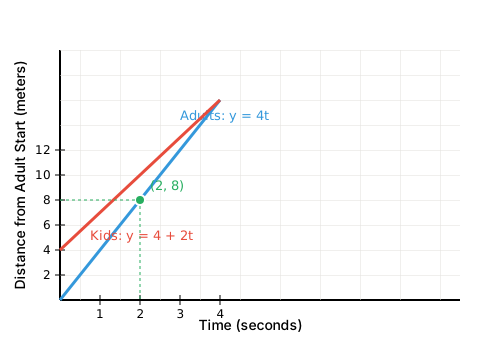
This coordinate graph shows both runners' positions over time. The adults start at the origin (0,0) with a steeper slope representing their faster speed. The kids start 4 meters ahead with a gentler slope. The intersection at (2, 8) tells us they meet after 2 seconds, when both are 8 meters from the adult starting line.
Solution: Method 1 — Position Equations Approach
Step 1 — Define variables and establish reference point
Let t = time in seconds from when both teams start moving. Let's measure all distances from the adults' starting line as our reference point (position = 0 for adults at t = 0).
Step 2 — Write position equations for each team
Since position = starting position + (rate × time), we get:
Kids: y = 4 + 2t
The adults start at position 0 and move at 4 m/s. The kids start 4 meters ahead (at position 4) and move at 2 m/s.
Step 3 — Set up the system of equations
We want to find when they're at the same position, so we set the equations equal:
Step 4 — Solve for time
Subtract 2t from both sides:
2t = 4
t = 2 seconds
Step 5 — Find how far the adults traveled
Substitute t = 2 back into the adults' equation:
Solution: Method 2 — Relative Speed Analysis
Step 1 — Identify the gap and closing rate
The kids have a 4-meter head start. The adults are gaining ground at a rate equal to the difference in their speeds:
Step 2 — Calculate time to close the gap
Using the relationship: time = distance ÷ rate
Step 3 — Find the adults' distance
In 2 seconds at 4 m/s, the adults travel:
System of Equations Summary
Adults:
y = 4tKids:
y = 4 + 2tSolution:
t = 2 seconds, y = 8 metersVerification
Let's check that both teams are at the same position after 2 seconds:
Kids after 2 seconds: y = 4 + 2(2) = 4 + 4 = 8 meters ✓
Both teams are indeed at the 8-meter mark after 2 seconds, confirming our solution.
Common Pitfalls
y = 2t + 4 vs. y = 4 + 2tWhile mathematically equivalent, this can cause confusion about which number represents the head start vs. the rate. Always write initial position first: starting position + rate × time.
Some students write both equations starting from 0: adults as
y = 4t and kids as y = 2t. This ignores the 4-meter head start and gives the wrong answer that they meet immediately.
The adults travel 8 meters, but the kids only travel 4 additional meters (from their starting position to the meeting point). The answer asks specifically how far the adults go: 8 meters.
The Underlying Pattern
This is a classic "catch-up" problem that follows a general pattern. For any situation where a faster object chases a slower object with a head start:
Slower object: y = h + r₂t
Where: r₁ > r₂, h = head start
They meet when the equations are equal, which gives:
This formula works for any catch-up scenario: pursuit problems in navigation, police chasing speeders, or even compound interest overtaking simple interest. The key insight is that the difference in rates determines how quickly the gap closes.
Real Applications
This mathematical structure appears frequently in real scenarios:
- Traffic and Navigation: A faster car leaving later to catch up to a slower car that left earlier — common in GPS route planning.
- Manufacturing: A faster production line trying to make up for lost time after starting behind schedule.
- Finance: Comparing investment growth rates where one investment starts with a higher principal but lower return rate.
- Project Management: Calculating when a team working overtime can catch up to a project that started ahead of schedule.
What If?
Adults: y = 4t, Kids: y = 6 + 2t
4t = 6 + 2t
2t = 6, so t = 3 seconds
Distance = 4 × 3 = 12 meters
After 3 seconds: Adults at 4(3) = 12m, Kids at 6 + 2(3) = 12m ✓
Adults: y = 4t, Kids: y = 4 + 2t, Teens: y = 2 + 3t
4t = 4 + 2t → t = 2 seconds
4t = 2 + 3t → t = 2 seconds
At t = 2: Distance = 4 × 2 = 8 meters
At t = 2: All teams at 8m. Adults: 4(2) = 8, Kids: 4 + 2(2) = 8, Teens: 2 + 3(2) = 8 ✓
When adults start (at t = 1), kids are at position: 4 + 2(1) = 6 meters
Let s = time since adults started. Adults: y = 4s, Kids: y = 6 + 2s
4s = 6 + 2s → 2s = 6 → s = 3 seconds
Distance = 4 × 3 = 12 meters
After adults run 3 seconds: Adults at 12m, Kids at 6 + 2(3) = 12m ✓
From distance = rate × time: 10 = 4t → t = 2.5 seconds
Kids: y = h + 2t where h is the unknown head start
At t = 2.5, both teams are at 10m: 10 = h + 2(2.5)
10 = h + 5 → h = 5 meters
Kids starting 5m ahead: y = 5 + 2(2.5) = 10m matches adults' 10m ✓
Frequently Asked Questions
2026-08-18