




When Will the Trees Be the Same Height? Linear Equations Problem
What This Problem Teaches
- Writing linear equations from real-world growth scenarios
- Setting up equations where one variable appears in multiple expressions
- Understanding "catch-up" problems where the faster rate starts behind
- Solving systems by substitution when equations are already solved for the same variable
- Interpreting intersection points as moments of equality in time-based problems
Visualizing the Growth
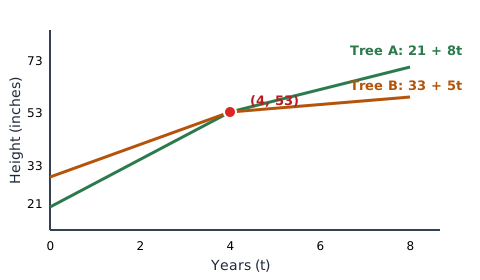
The graph shows both trees' growth over time. Tree A starts shorter but grows faster, eventually catching up to Tree B after 4 years when both reach 53 inches.
Solution: The Equation Approach
Step 1 — Write the growth equation for each tree
Each tree's height follows the pattern: Current Height = Initial Height + Growth Rate × Time
Tree A: Starts at 21 inches, grows 8 inches per year
Tree B: Starts at 33 inches, grows 5 inches per year
Step 2 — Set the heights equal to find when they're the same
When the trees have equal height, A(t) = B(t):
Step 3 — Solve for t
Subtract 5t from both sides:
Subtract 21 from both sides:
Divide by 3:
Step 4 — Find the height at that time
Substitute t = 4 into either equation. Using Tree A's equation:
Solution: Method 2 — The Gap-Closing Analysis
Step 1 — Find the initial gap between trees
Tree B starts ahead by: 33 - 21 = 12 inches
Step 2 — Calculate how fast Tree A closes the gap
Each year, Tree A gains: 8 - 5 = 3 inches on Tree B
Step 3 — Find when the gap closes completely
Time to close 12-inch gap at 3 inches per year:
Step 4 — Calculate the height at that time
After 4 years, Tree A's height:
Tree A equation: A(t) = 21 + 8t
Tree B equation: B(t) = 33 + 5t
Verification
Let's check both trees at t = 4 years:
Tree A:A(4) = 21 + 8(4) = 21 + 32 = 53 inches ✓
Tree B:B(4) = 33 + 5(4) = 33 + 20 = 53 inches ✓
Both trees are exactly 53 inches tall after 4 years, confirming our answer.
We can also verify the pattern makes sense: Tree A starts 12 inches behind but gains 3 inches per year on Tree B. After 4 years, Tree A gains 4 × 3 = 12 inches on Tree B, exactly closing the initial gap.
Common Pitfalls
✗ Mistake: Writing the equations as A(t) = 8t and B(t) = 5t
Why it's wrong: This ignores the initial heights and assumes both trees start at 0 inches. The trees don't start from nothing—they begin with heights of 21 and 33 inches respectively.
✗ Mistake: Solving 21 + 8t = 33 + 5t and getting t = -4
Why it's wrong: This happens when you incorrectly move terms: 8t - 5t = 33 - 21 gives 3t = 12, not -3t = 12. Negative time doesn't make sense in this context—we're looking forward from planting, not backward.
✗ Mistake: Adding the growth rates: "They grow 8 + 5 = 13 inches per year combined"
Why it's wrong: We're not looking for combined growth—we want to know when individual heights are equal. The trees grow independently, and we need to track each one separately until they meet.
The Pattern Behind This
This is a classic "catch-up" linear equation problem. The general pattern is:
Object 2: h₂(t) = initial₂ + rate₂ × t
Equal when: initial₁ + rate₁ × t = initial₂ + rate₂ × t
The solution follows a predictable structure:
- Gap: |initial₂ - initial₁| = how far apart they start
- Closing rate: |rate₁ - rate₂| = how fast the gap changes
- Catch-up time: Gap ÷ Closing rate = when they meet
Important note: This only works when the faster rate belongs to the object starting behind. If the object starting ahead also grows faster, they'll never meet!
Real Applications
This catch-up pattern appears frequently in real scenarios:
- Population growth: Smaller cities growing faster than larger ones, eventually reaching equal populations
- Investment accounts: An account starting with less money but earning higher interest, catching up to a larger account with lower returns
- Manufacturing: Two production lines with different starting inventories but different production rates reaching equal output
Four "What-If?" Problems
Different Starting Gap
Tree C: C(t) = 15 + 9t
Tree D: D(t) = 40 + 4t
15 + 9t = 40 + 4t5t = 25t = 5
C(5) = 15 + 9(5) = 60 inches
D(5) = 40 + 4(5) = 60 inches ✓
Answer: 5 years, 60 inches tall
Reverse Engineering
Tree 1: 25 + 3(8) = 25 + 24 = 49 inches after 8 years
Tree 2: 45 + r(8) where r is unknown growth rate
49 = 45 + 8r
4 = 8rr = 0.5 inches per year
Tree 2 after 8 years: 45 + 0.5(8) = 49 inches ✓
Answer: 0.5 inches per year
Three Trees Competition
Tree A: A(t) = 21 + 8t
Tree C: C(t) = 10 + 11t
21 + 8t = 10 + 11t
21 - 10 = 11t - 8t11 = 3tt = 11/3 ≈ 3.67 years
A(11/3) = 21 + 8(11/3) = 21 + 88/3 = 151/3 ≈ 50.33 inches
C(11/3) = 10 + 11(11/3) = 10 + 121/3 = 151/3 inches ✓
Answer: 3⅔ years, 50⅓ inches tall
Growth Rate Changes
A(3) = 21 + 8(3) = 45 inches
B(3) = 33 + 5(3) = 48 inches
Let s = years after year 3
Tree A: 45 + 4s
Tree B: 48 + 5s
45 + 4s = 48 + 5s45 - 48 = 5s - 4s-3 = s
Since s = -3 is negative, this equality would have occurred 3 years before year 3, which contradicts our setup. After Tree A slows down, Tree B pulls further ahead each year.
Answer: No, they never become equal height after the growth rate change.
Frequently Asked Questions
2026-07-14