




Car Overtaking Truck: Relative Speed & Catch-Up Problem
Visualizing the Situation
Before diving into the algebra, let's picture what's happening on this highway.
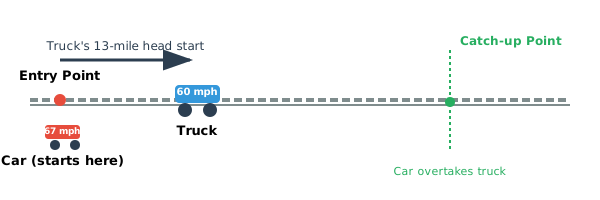
The truck gets a 13-minute head start before the car even enters. Once both vehicles are on the highway, the car needs to make up that initial gap while both vehicles continue moving forward.
What This Problem Teaches
- Converting between time units (minutes to hours) for consistent calculations
- Understanding relative speed as the rate at which one object gains on another
- Setting up distance equations when objects start at different times
- Recognizing that "catch-up" problems involve closing an initial gap
- Interpreting fractional answers in practical time contexts
Solution: Method 1 — The Gap-Closing Approach
The most intuitive way to think about this problem is that the car needs to close the gap created by the truck's 13-minute head start.
Step 1 — Convert the head start time to hours
Since our speeds are in mph, we need consistent time units. Convert 13 minutes to hours:
Step 2 — Calculate the truck's head start distance
While the car is still off the highway, the truck travels for 13 minutes at 60 mph:
Head start distance = 60 mph × (13/60) hours = 13 miles
Step 3 — Find the relative closing speed
Once the car enters the highway, both vehicles move in the same direction. The car closes the gap at the difference between their speeds:
Relative speed = 67 mph - 60 mph = 7 mph
Step 4 — Calculate time to close the gap
Now we can find how long it takes the car to close the 13-mile gap at a relative speed of 7 mph:
Time = 13 miles ÷ 7 mph = 13/7 hours
Step 5 — Convert to mixed time format
To express this in a more practical format:
= 1 hour + (6/7 × 60) minutes
= 1 hour + 51.43 minutes
≈ 1 hour 51 minutes
Solution: Method 2 — Equating Distances from Start
An alternative approach is to set up equations based on how far each vehicle has traveled from the original entry point.
Step 1 — Define the variable
Let t = hours the car drives until it catches the truck
Step 2 — Express the truck's total travel time
The truck has been driving for 13 minutes longer than the car:
Step 3 — Set up distance equations
When the car catches the truck, both vehicles are the same distance from the entry point:
67t = 60(t + 13/60)
67t = 60t + 60 × (13/60)
67t = 60t + 13
Step 4 — Solve for t
Isolate the variable to find the catch-up time:
67t - 60t = 13
7t = 13
t = 13/7 hours
This confirms our answer from Method 1: the car will catch the truck after driving for 13/7 hours.
Verification
Let's check our answer by calculating where both vehicles are when the car catches the truck.
Car's position after 13/7 hours:
Truck's position after 13/7 hours:
Remember, the truck has been driving for 13/7 + 13/60 hours total.
Distance = 60 mph × (871/420) hours = 60 × 871/420 = 52260/420 ≈ 124.43 miles
✓ Both vehicles are at the same position, confirming our answer is correct.
Common Pitfalls
Some students calculate closing speed as 67 + 60 = 127 mph. This would be correct if the vehicles were moving toward each other, but they're moving in the same direction. The car only gains on the truck at the difference: 67 - 60 = 7 mph.
Using 13 minutes directly with speeds in mph leads to unit mismatches. Always convert to consistent units first: 13 minutes = 13/60 hours before calculating with mph.
The question asks "from the time the car enters the highway." Some students add the 13-minute head start to their answer, but the clock starts ticking when the car begins driving, not when the truck started.
A few students think the car catches the truck in 13 minutes because that's the head start time. But during those 13 minutes, the truck continues moving forward, so it takes longer to close the gap.
The Underlying Pattern
This problem follows the standard relative motion formula for same-direction pursuit:
Where:
• Head start distance = (slower speed) × (head start time)
• Relative speed = (faster speed) - (slower speed)
This pattern appears whenever a faster object pursues a slower object that had a head start. The key insight is that once both objects are moving, the gap closes at the difference in their speeds, not their individual speeds.
Real Applications
- Military and law enforcement: Calculating intercept times for pursuing vehicles or aircraft
- Logistics and delivery: Determining when a faster truck can overtake a slower convoy
- Sports analytics: Analyzing when a trailing runner can catch the leader in distance races
- Network communications: Computing when faster data packets catch up to slower ones in network traffic analysis
What If?
Head start distance = 60 mph × (13/60) hours = 13 miles
Relative speed = 72 - 60 = 12 mph
Time = 13 miles ÷ 12 mph = 13/12 hours ≈ 1.08 hours
13/12 hours × 60 = 65 minutes = 1 hour 5 minutes
Answer: 13/12 hours, or about 1 hour 5 minutes
Verification: Car position: 72 × (13/12) = 78 miles. Truck position: 60 × (13/12 + 13/60) = 78 miles ✓
When they meet: Car distance = Truck distance
67 × 2 = 60 × (2 + head start in hours)
134 = 120 + 60 × (head start)
14 = 60 × (head start)
Head start = 14/60 hours
(14/60) hours × 60 minutes/hour = 14 minutes
Head start distance = 60 × (14/60) = 14 miles
Relative speed = 67 - 60 = 7 mph
Catch-up time = 14 ÷ 7 = 2 hours ✓
Answer: 14 minutes
From the original problem: they meet after 13/7 hours ≈ 1.857 hours
Distance = Car's speed × time = 67 × (13/7) = 871/7 ≈ 124.4 miles
Meeting point: 124.4 miles
Weigh station: 150 miles
124.4 < 150, so yes!
Safety margin = 150 - 124.4 = 25.6 miles
Answer: Yes, the car will catch the truck about 25.6 miles before the weigh station
Car drives alone for 10 minutes = 10/60 = 1/6 hour
Head start distance = 67 × (1/6) = 67/6 miles
Motorcycle vs car relative speed = 80 - 67 = 13 mph
Time = distance ÷ relative speed
Time = (67/6) ÷ 13 = 67/78 hours
(67/78) hours × 60 = 4020/78 ≈ 51.5 minutes
Answer: 67/78 hours, or about 51.5 minutes after the motorcycle enters
Verification: Motorcycle travels 80 × (67/78) ≈ 68.7 miles. Car travels 67 × (67/78 + 1/6) ≈ 68.7 miles ✓
Frequently Asked Questions
2026-08-19