




Venn Diagram: Counting Students in Multiple Classes
What This Problem Teaches
- How to organize overlapping data using Venn diagrams
- Understanding the difference between "and" (intersection) vs "or" (union) in set theory
- Converting word problems into visual representations
- Using complement counting to find exclusions
- Breaking complex counting into systematic steps
Visualizing the Problem
Before diving into calculations, let's draw what we know. The Venn diagram below shows how the students are distributed across Math and English classes:
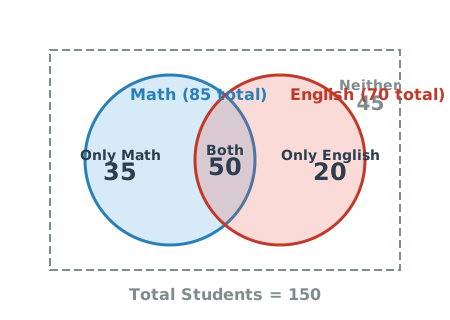
The key insight is that we must start with the overlap region (both classes) and work outward to avoid double-counting students.
Solution: Method 1 — The Fill-From-Center Approach
Step 1 — Start with the intersection
The problem tells us directly that 50 students are registered for both Math and English. This number goes in the overlapping region of our Venn diagram.
Step 2 — Calculate students in only Math
We know 85 students total are in Math, but 50 of these are also in English. So students in only Math:
Only Math = 85 - 50 = 35
Step 3 — Calculate students in only English
Similarly, 70 students total are in English, but 50 are also in Math. So students in only English:
Only English = 70 - 50 = 20
Step 4 — Find students in Math OR English (the union)
To find students in at least one class, we add all three regions inside either circle:
Math or English = 35 + 50 + 20 = 105
Step 5 — Calculate students in neither class
Finally, subtract the union from the total population:
Neither = 150 - 105 = 45
a. Only Math: 35 students
b. Only English: 20 students
c. Math or English: 105 students
d. Neither: 45 students
Solution: Method 2 — The Inclusion-Exclusion Formula
We can also solve this using the formal inclusion-exclusion principle, which provides a direct formula for unions.
Step 1 — Apply the inclusion-exclusion formula
The formula for the size of a union is:
|Math ∪ English| = 85 + 70 - 50 = 105
Step 2 — Find the complement
Students in neither class:
Neither = 150 - 105 = 45
Step 3 — Calculate exclusive regions
Now we can find the "only" categories by subtracting the intersection:
Only English = |English| - |Math ∩ English| = 70 - 50 = 20
This method is faster when you need the union first, but both approaches yield identical results.
Verification
Let's verify our answers by checking that all regions sum to the total:
= 35 + 50 + 20 + 45
= 150 ✓
We can also verify the individual totals:
Total English = Only English + Both = 20 + 50 = 70 ✓
All our calculations check out perfectly.
Watch Out For These Mistakes
✗ Common Error: Adding the totals directly: 85 + 70 = 155
This double-counts the 50 students who are in both classes. The correct union is 85 + 70 - 50 = 105.
✗ Common Error: Confusing "only Math" with "total Math"
The question asks for students in only Math (35), not the total in Math (85). Always read carefully whether the question wants exclusive or inclusive counts.
✗ Common Error: Forgetting to account for the "neither" category
Students who take neither class exist outside both circles but are still part of the total population. Don't assume everyone must be in at least one category unless stated.
The Pattern Behind This
This problem follows the fundamental inclusion-exclusion principle for two sets:
Where:
• A ∪ B is the union (A or B)
• A ∩ B is the intersection (A and B)
• |A| means "size of set A"
This formula works because when we add |A| + |B|, we count the intersection twice, so we must subtract it once. This principle extends to three sets, four sets, and beyond, though the formulas become more complex.
Key Insight: In any Venn diagram problem, always start by filling in the intersection regions first, then work outward to the exclusive regions. This prevents double-counting and ensures your diagram accurately represents the data.
How to Spot This Problem Type
Look for these telltale signs that signal a Venn diagram approach:
- "Both" or "all" — indicates an intersection
- "Or" vs "and" — union vs intersection language
- "Only" or "exclusively" — exclusive regions
- "Neither" or "none" — complement regions
- Multiple categories with overlapping membership
- Survey data about preferences, enrollments, or characteristics
The phrase "registered for both" is the dead giveaway that you need to account for overlapping membership in your count.
Four "What-If?" Problems
60 students take both classes.
Only Math = 110 - 60 = 50
Only English = 90 - 60 = 30
Math or English = 50 + 60 + 30 = 140
Neither = 200 - 140 = 60
Answers: Only Math: 50, Only English: 30, Math or English: 140, Neither: 60
Math or English = 180 - 25 = 155
|Math ∪ English| = |Math| + |English| - |Both|
155 = 95 + 85 - |Both|155 = 180 - |Both||Both| = 180 - 155 = 25
Only Math: 95 - 25 = 70
Only English: 85 - 25 = 60
Total: 70 + 25 + 60 + 25 = 180 ✓
Answer: 25 students take both Math and English
20 students take all three subjects.
Only Math & English = 60 - 20 = 40
Only Math & History = 40 - 20 = 20
Only English & History = 30 - 20 = 10
Exactly two subjects = 40 + 20 + 10 = 70
At least one = 150 + 120 + 100 - 60 - 40 - 30 + 20 = 260
Only one = 260 - 70 - 20 = 170
Check: 170 + 70 + 20 = 260 ✓
Answer: 70 students take exactly two subjects
Let x = students who like both
Then 2x = students who like neither
Students who like at least one = 70 + 60 - x = 130 - x
(At least one) + (Neither) = Total(130 - x) + 2x = 120130 + x = 120x = -10
Negative overlap is impossible. Let's try: both = y, neither = y/2(130 - y) + y/2 = 120130 - y/2 = 120y/2 = 10, so y = 20
Answer: 20 students like both (and 10 like neither)
Frequently Asked Questions
2026-05-23