




Find Points for Silver and Gold Coins
What This Problem Teaches
- Setting up a system of linear equations from word problem constraints
- Recognizing when two unknowns require two separate equations
- Solving systems using elimination and substitution methods
- Translating between mathematical notation and real-world scenarios
- Verifying solutions by checking against original conditions
Visualizing the Game
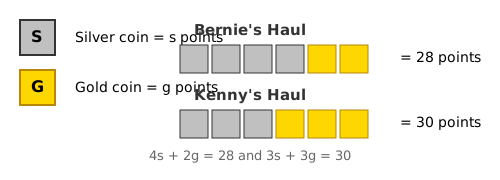
Solution: Method 1 — The System of Equations Approach
Step 1 — Define variables for the unknown point values
Let s = points earned by finding one silver coin
Let g = points earned by finding one gold coin
Step 2 — Translate Bernie's game into an equation
Bernie finds 4 silver coins and 2 gold coins for 28 points total. This gives us:
4s + 2g = 28Step 3 — Translate Kenny's game into a second equation
Kenny finds 3 silver coins and 3 gold coins for 30 points total. This gives us:
3s + 3g = 30Step 4 — Simplify the second equation
We can divide Kenny's equation by 3 to make the coefficients smaller:
3s + 3g = 30s + g = 10Step 5 — Solve using substitution
From the simplified equation, we can express g in terms of s:
s + g = 10g = 10 - sSubstitute this into Bernie's equation:
4s + 2g = 284s + 2(10 - s) = 284s + 20 - 2s = 282s + 20 = 282s = 8s = 4Step 6 — Find the value of gold coins
Now substitute s = 4 back into g = 10 - s:
g = 10 - 4 = 6Solution: Method 2 — The Elimination Strategy
Step 1 — Set up the system of equations
Starting with our two equations from the problem:
4s + 2g = 28 ... (Equation 1)3s + 3g = 30 ... (Equation 2)
Step 2 — Prepare equations for elimination
To eliminate one variable, we need matching coefficients. Let's eliminate s by making the coefficients of s the same. Multiply Equation 1 by 3 and Equation 2 by 4:
3(4s + 2g) = 3(28) → 12s + 6g = 844(3s + 3g) = 4(30) → 12s + 12g = 120Step 3 — Eliminate s by subtraction
Subtract the first equation from the second:
(12s + 12g) - (12s + 6g) = 120 - 8412s + 12g - 12s - 6g = 366g = 36g = 6Step 4 — Substitute back to find s
Use g = 6 in the original first equation:
4s + 2(6) = 284s + 12 = 284s = 16s = 4Verification
Let's check our answer by substituting s = 4 and g = 6 back into both original conditions:
Bernie's game check:
4 silver + 2 gold = 4(4) + 2(6) = 16 + 12 = 28 ✓
Kenny's game check:
3 silver + 3 gold = 3(4) + 3(6) = 12 + 18 = 30 ✓
Both totals match perfectly, confirming our solution is correct.
Common Pitfalls
✗ Assuming gold and silver are worth the same
Some students try s = g and solve 6s = 28 from Bernie's game, getting s = 4.67. But then Kenny's game gives 6s = 30, so s = 5. The contradiction shows the coins must have different values.
✗ Setting up only one equation
With two unknowns, you need two independent equations. Using only Bernie's data gives infinitely many solutions — silver could be 2 points and gold 10, or silver could be 6 points and gold 2, etc.
✗ Mixing up the coefficients
Writing 2s + 4g = 28 instead of 4s + 2g = 28 flips which coin Bernie found more of. Always double-check that your equation matches the problem description.
The General Formula
Any problem where you have two unknowns and two linear constraints follows this pattern:
a₁x + b₁y = c₁a₂x + b₂y = c₂The solution exists and is unique when the equations are not multiples of each other (mathematically, when the determinant a₁b₂ - a₂b₁ ≠ 0). In our coin problem, this determinant is (4)(3) - (3)(2) = 12 - 6 = 6 ≠ 0, confirming a unique solution exists.
Real-world insight: This same mathematical structure appears everywhere — mixing concentrations in chemistry, balancing nutrients in diet planning, or determining hourly rates for different types of work.
Four "What-If?" Problems
Let s = silver points, g = gold points. Bernie: 3s + 4g = 39. Kenny: 2s + 1g = 16.
2s + g = 16 → g = 16 - 2s
3s + 4(16 - 2s) = 39 → 3s + 64 - 8s = 39 → -5s = -25 → s = 5
g = 16 - 2(5) = 6
Bernie: 3(5) + 4(6) = 15 + 24 = 39 ✓. Kenny: 2(5) + 1(6) = 16 ✓
Silver = 5 points, Gold = 6 points
Bronze = 3 points each. Bernie's bronze contribution: 3 × 3 = 9. Kenny's: 1 × 3 = 3.
Bernie: 2s + 1g + 9 = 25 → 2s + g = 16
Kenny: 1s + 2g + 3 = 23 → s + 2g = 20
From equation 1: g = 16 - 2s
Substitute: s + 2(16 - 2s) = 20 → s + 32 - 4s = 20 → -3s = -12 → s = 4
g = 16 - 2(4) = 8
Bernie: 2(4) + 1(8) + 3(3) = 8 + 8 + 9 = 25 ✓
Kenny: 1(4) + 2(8) + 1(3) = 4 + 16 + 3 = 23 ✓
Silver = 4 points, Gold = 8 points
Bernie: 5s + 1g = 26, where s = 4
5(4) + g = 26 → 20 + g = 26 → g = 6
Kenny: 2s + 4g = 2(4) + 4(6) = 8 + 24 = 32 ✓
We could also use Kenny's equation: 2(4) + 4g = 32 → 8 + 4g = 32 → 4g = 24 → g = 6
Gold coins are worth 6 points each.
Lisa: 6 × 4 + 2 × 6 = 24 + 12 = 36 points
Mike needs: 4s + 6g = 40, where s and g are non-negative integers
Rearrange: s = (40 - 6g)/4 = 10 - 1.5g
For s to be a whole number, g must be even.
Try even values: g = 0 → s = 10; g = 2 → s = 7; g = 4 → s = 4; g = 6 → s = 1
Option 1: 10 silver, 0 gold → 10(4) + 0(6) = 40 ✓
Option 2: 7 silver, 2 gold → 7(4) + 2(6) = 28 + 12 = 40 ✓
Option 3: 4 silver, 4 gold → 4(4) + 4(6) = 16 + 24 = 40 ✓
Frequently Asked Questions
2026-07-05