




Plane Speed Problem: Finding Wind Speed and Airspeed
What This Problem Teaches
- Setting up systems of equations from relative motion scenarios
- Understanding the difference between airspeed and ground speed
- Converting time units and working with rates in different units
- Solving problems where the unknown appears in both addition and subtraction
- Interpreting solutions in the context of real-world physics
Picture This
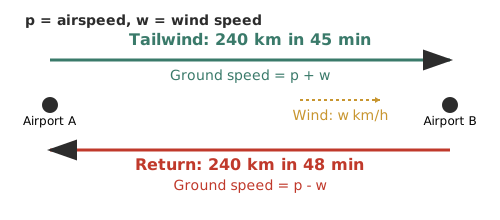
Solution: Method 1 — The System of Equations Approach
This is a classic relative velocity problem. The plane's speed relative to the ground changes depending on wind direction, but its airspeed through the air remains constant.
Step 1 — Convert time units
First, let's convert the times to hours since our distance is in kilometers:
48 minutes = 48/60 = 0.8 hours
Step 2 — Define variables
Let p = airspeed of the plane (km/h) and w = wind speed (km/h). With a tailwind, the ground speed is p + w. Against the wind, it's p - w.
Step 3 — Set up equations using distance = speed × time
For the tailwind leg:
For the return trip (headwind):
Step 4 — Solve the first equation for p + w
Step 5 — Solve the second equation for p - w
Step 6 — Add the equations to eliminate w
Adding p + w = 320 and p - w = 300:
2p = 620
p = 310 km/h
Step 7 — Substitute to find w
Using p + w = 320:
w = 10 km/h
Solution: Method 2 — The Speed Difference Approach
We can also solve this by recognizing that the difference in ground speeds equals twice the wind speed.
Step 1 — Calculate ground speeds directly
Tailwind ground speed = 240 km ÷ 0.75 h = 320 km/h
Headwind ground speed = 240 km ÷ 0.8 h = 300 km/h
Step 2 — Find the speed difference
The difference between these speeds is:
Step 3 — Connect difference to wind speed
This 20 km/h difference equals (p + w) - (p - w) = 2w
w = 10 km/h
Step 4 — Calculate airspeed
The airspeed is the average of the two ground speeds:
Verification
Let's check both legs of the journey:
Tailwind leg:
Time = 240 km ÷ 320 km/h = 0.75 h = 45 minutes ✓
Headwind leg:
Time = 240 km ÷ 300 km/h = 0.8 h = 48 minutes ✓
Both calculations match the given times, confirming our solution is correct.
Does This Seem Reasonable?
Our answer makes perfect sense when we consider the physics:
The airspeed of 310 km/h is reasonable for a small aircraft, and the 10 km/h wind speed is a moderate but noticeable breeze. The fact that the wind caused a relatively small time difference (3 minutes on a 45-48 minute flight) confirms that we're dealing with realistic values.
Common Pitfalls
Some students calculate 240 km ÷ 45 min and think this is the plane's speed. But this gives ground speed with tailwind, not airspeed. The plane's airspeed through the air is constant; ground speed changes with wind.
When flying against the wind, ground speed = airspeed - wind speed, not airspeed + wind speed. The wind opposes the plane's motion, reducing its effective speed over the ground.
Working with minutes and hours mixed up leads to wrong equations. Always convert to consistent units first — either all minutes or all hours.
The Pattern Behind This
This problem follows the standard relative velocity template. For any object moving in a medium that's also moving:
Against current/wind: effective speed = object speed - medium speed
The general solution method:
- Set up two equations using distance = speed × time
- Add equations to find object speed
- Subtract equations to find medium speed
This same structure appears in boat problems (water current), conveyor belt problems, and even sound wave problems where the medium is moving.
Why This Matters
Understanding relative velocity is crucial in many real-world contexts:
- Aviation: Pilots must account for wind when calculating flight times and fuel requirements
- Maritime navigation: Ship captains consider ocean currents when plotting courses
- Physics and engineering: Designing aircraft, analyzing fluid flow, understanding wave propagation
- GPS systems: Satellites account for Earth's rotation and atmospheric effects
Four "What-If?" Problems
50 minutes = 50/60 = 5/6 hours, 75 minutes = 75/60 = 1.25 hours
Tailwind: (p + w) × (5/6) = 300
Headwind: (p - w) × 1.25 = 300
p + w = 300 ÷ (5/6) = 300 × (6/5) = 360 km/hp - w = 300 ÷ 1.25 = 240 km/h
Adding: 2p = 360 + 240 = 600, so p = 300 km/h
Subtracting: 2w = 360 - 240 = 120, so w = 60 km/h
Answer: Airspeed = 300 km/h, Wind speed = 60 km/h
Check: 360 km/h × (5/6) h = 300 km ✓, 240 km/h × 1.25 h = 300 km ✓
Ground speed with headwind = 280 - 20 = 260 km/h
Time = 420 km ÷ 260 km/h = 1.615 hours = 96.9 minutes
Ground speed with tailwind = 280 + 20 = 300 km/h
Time = 420 km ÷ 300 km/h = 1.4 hours = 84 minutes
Time saved = 96.9 - 84 = 12.9 minutes
Answer: Headwind flight takes 97 minutes. Changing to tailwind saves 13 minutes.
With no wind effect: airspeed = ground speedp = 150 km ÷ (25/60) h = 150 ÷ (5/12) = 360 km/h
Tailwind ground speed = 150 ÷ (20/60) = 150 ÷ (1/3) = 450 km/h
Since ground speed = airspeed + wind speed:450 = 360 + w, so w = 90 km/h
Headwind ground speed should be 360 - 90 = 270 km/h
Check: 150 km ÷ 270 km/h = 0.556 h = 33.3 minutes
Given: 30 minutes (close - small rounding differences expected)
Answer: Airspeed = 360 km/h, Wind speed = 90 km/h
(Note: The 3-minute discrepancy suggests measurement error or rounding in the original data)
Let w = wind speed. One leg has ground speed 320 + w, other has 320 - w
Total time: 400/(320 + w) + 400/(320 - w) = 2.6
400(320 - w) + 400(320 + w) = 2.6(320 + w)(320 - w)400(320 - w + 320 + w) = 2.6(320² - w²)400 × 640 = 2.6(102400 - w²)
256000 = 2.6(102400 - w²)256000/2.6 = 102400 - w²98461.5 = 102400 - w²w² = 3938.5, so w = 62.8 km/h
Answer: Wind speed ≈ 63 km/h
Without wind: 2 × (400/320) = 2.5 hours
With wind: 2.6 hours (slower overall)
Conclusion: Wind hindered the journey despite helping one leg.
Frequently Asked Questions
2026-09-09