




Ratio Proportion Problem: Boys and Girls in Martial Arts Class
What This Problem Teaches
- How to interpret ratio language ("for every...there are...") and convert it to mathematical relationships
- Setting up proportions from given ratios and total quantities
- Working with part-to-part ratios versus part-to-whole relationships
- Two distinct algebraic approaches: cross-multiplication and the parts method
- Verification strategies for ratio problems using both addition and division checks
Let's Draw It
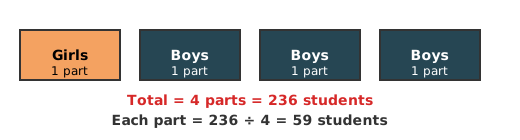
This bar model shows how the 1:3 ratio creates 4 equal parts total. Girls occupy 1 part, boys occupy 3 parts.
Solution: Method 1 — The Parts Approach
Step 1 — Understand the ratio structure
The phrase "for every girl there are 3 boys" tells us the ratio is girls : boys = 1 : 3. This means our total student body is divided into 1 + 3 = 4 equal parts.
Step 2 — Find the value of each part
If 4 parts equal 236 total students, then each part contains:
Step 3 — Calculate boys and girls
Now we can find the actual numbers:
Step 4 — Write the proportion as requested
The problem asks us to write a proportion. Using our known ratio:
Solution: Method 2 — Cross-Multiplication Method
Step 1 — Define variables and set up the proportion
Let b = number of boys. Then the number of girls is 236 - b. Since girls to boys is 1:3:
Step 2 — Cross-multiply
Cross-multiplication gives us:
Step 3 — Solve for b
Collect like terms:
Step 4 — Find the number of girls
Number of girls = 236 - 177 = 59
Verification
Let's check our answer using both addition and ratio verification:
Addition check
Ratio check
This confirms our 1:3 ratio (for every 1 girl, there are 3 boys). ✓
Proportion verification
Common Pitfalls
Some students think this means 3 total students for every 1 girl, leading to 236 ÷ 3 ≈ 79 girls. This ignores that boys are in addition to girls, not the total.
Writing
boys/girls = 1/3 instead of girls/boys = 1/3. Always check: "1 girl for every 3 boys" means girls are the smaller group, so girls/boys should equal the smaller number over the larger.
The problem asks for the number of boys, but some students stop after finding there are 59 girls. Always identify what the question is asking for before you start solving.
The Pattern Behind This
This is a classic part-to-part ratio with a given total problem. The general approach works like this:
For our problem: m = 1, n = 3, T = 236, so girls = 1 × 59 = 59 and boys = 3 × 59 = 177.
This pattern applies to any situation where you know the ratio between parts and the total amount: ingredients in a recipe, different types of vehicles in a parking lot, age relationships, etc.
How to Spot This Problem Type
Watch for these key phrases that signal a ratio-proportion problem:
- "For every..." followed by quantities
- "The ratio of ... to ... is"
- "There are X times as many"
- Any problem giving you a relationship between parts and asking for specific quantities
The dead giveaway is being told both a relationship between two groups and a total amount. That combination almost always leads to the parts method we used here.
Also look for problems that explicitly ask you to "write and solve a proportion" — this tells you the teacher wants to see the cross-multiplication method, even if the parts method is faster.
Real Applications
- Recipe scaling: "For every 2 cups flour, use 3 eggs. If I have 15 eggs total, how much flour do I need?" Same mathematical structure.
- Business planning: Staffing ratios like "1 supervisor for every 8 workers" help determine hiring needs when you know total workforce size.
- Medical dosing: "Give 2 mg per 5 kg body weight" creates a proportion to find the exact dose for any patient weight.
- Sports analytics: Win-loss ratios, player statistics, and team compositions all use proportional reasoning to make predictions.
What If?
If the ratio is 1:3 (girls:boys) and there are 177 boys, then girls = 177 ÷ 3 = 59
Total students = 59 girls + 177 boys = 236 students
Check: 177 ÷ 59 = 3, confirming 1:3 ratio ✓
236 total students
Ratio 2:5 means 2 + 5 = 7 total parts
Each part = 210 ÷ 7 = 30 students
Girls = 2 × 30 = 60, Boys = 5 × 30 = 150
60 + 150 = 210 ✓ and 150 ÷ 60 = 2.5 = 5/2 ✓
150 boys
Girls : Boys : Adults = 1 : 3 : 1, so total parts = 1 + 3 + 1 = 5
Each part = 180 ÷ 5 = 36 people
Girls = 1 × 36 = 36, Boys = 3 × 36 = 108, Adults = 1 × 36 = 36
36 + 108 + 36 = 180 ✓
108 boys
Using 1:3 ratio with 236 total: Girls = 59, Boys = 177
New girls = 59 + 8 = 67, New boys = 177 - 12 = 165
Girls : Boys = 67 : 165. Simplify by dividing both by their GCD.
67 ÷ 67 = 1 and 165 ÷ 67 ≈ 2.46, so approximately 1 : 2.46
67:165 or approximately 1:2.46
Frequently Asked Questions
2026-11-11